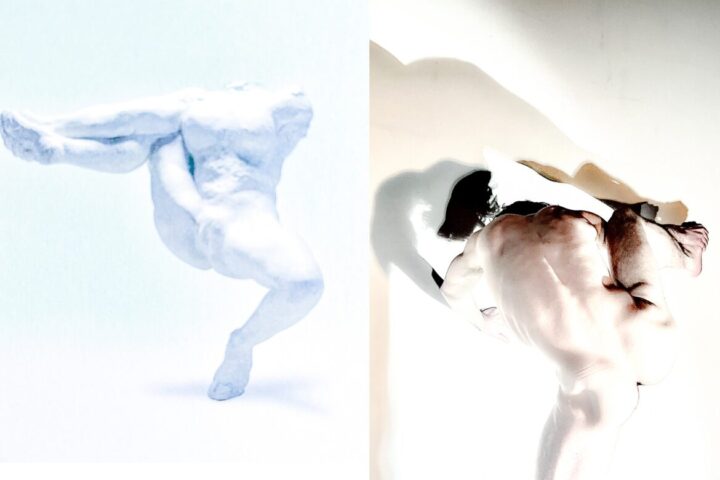
HOLD&RESIST_a springrite
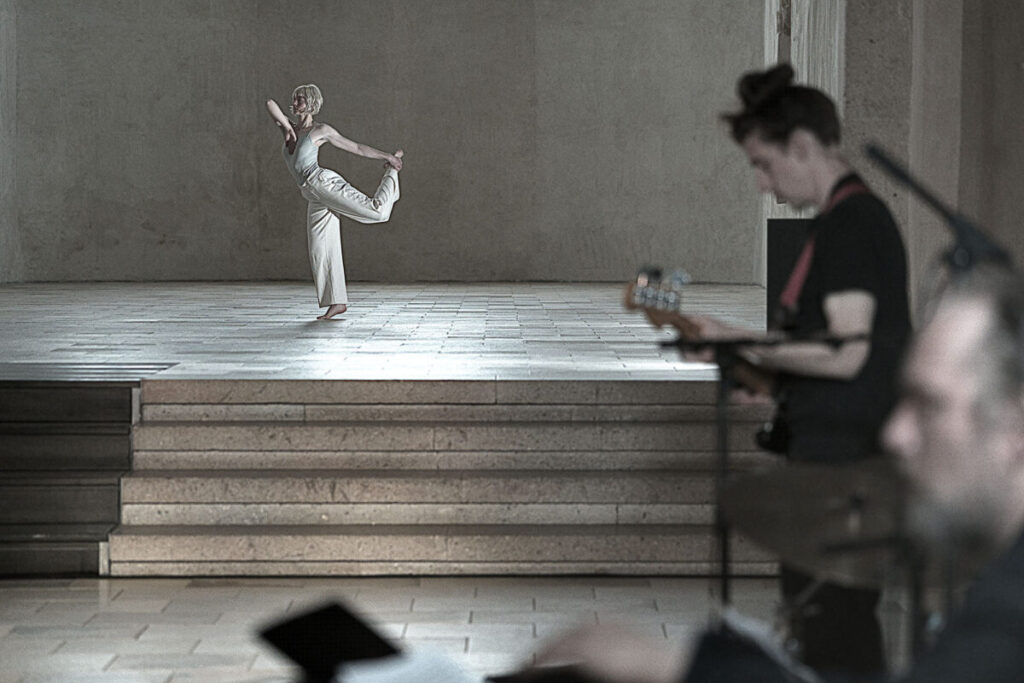
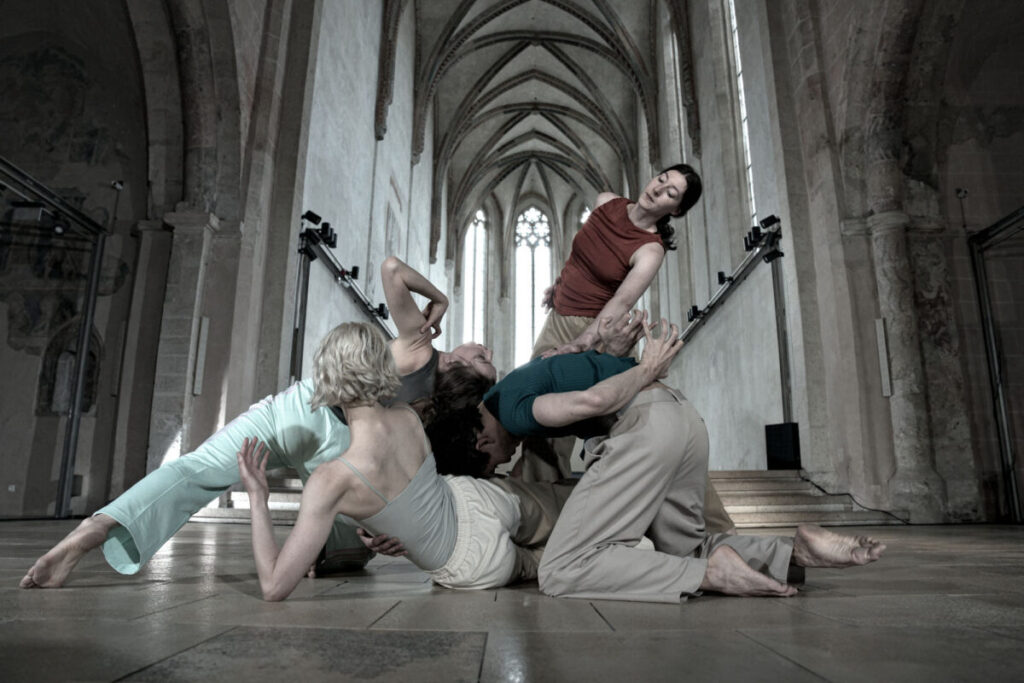
Die Gravitation wirkt nicht überall gleich. Im All sind wir schwerelos. In den zum delikat swingenden Ambientnoise der Metarock-Elektronikformation Radian in Szene gesetzten Versuchsanordnungen der Performancegruppe Liquid Loft wird das Potential des Körpers im Konflikt mit dem Diktat der Schwerkraft ausgelotet. Eine Pose überdehnen, die Erschöpfung ausreizen, eine Spannung aushalten, die den Naturgesetzen widerspricht. Politisch gesprochen: eine widerständige Haltung einnehmen, die erdrückenden Umständen und autoritären Tendenzen trotzt. Durchhalten, Standhalten, Position halten.
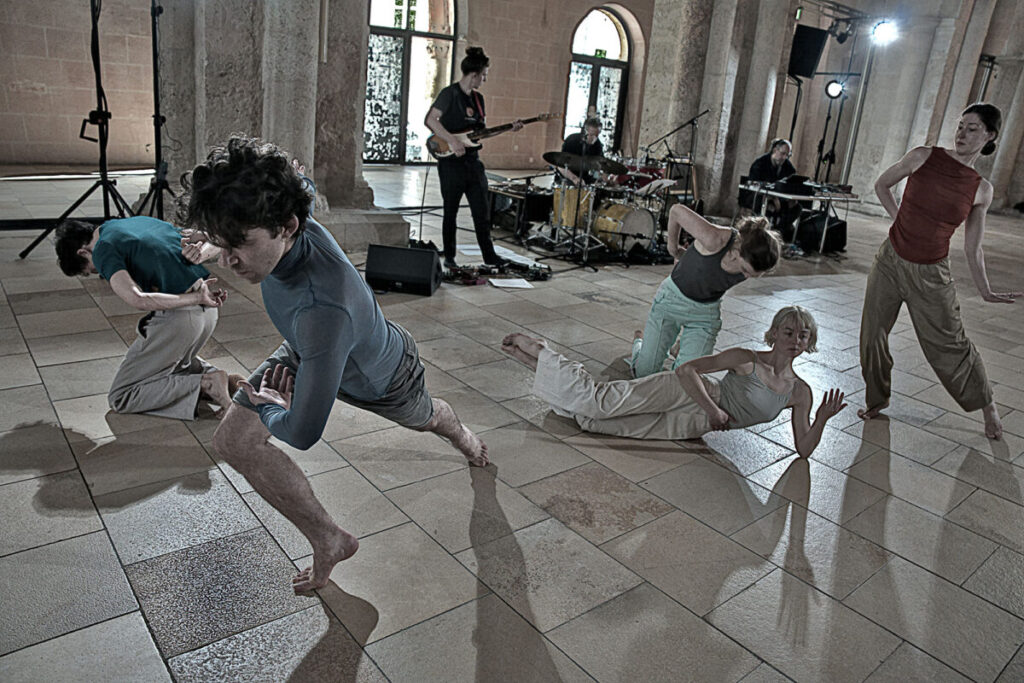
Hoffnung auf das Unwahrscheinliche, aber eben doch Mögliche bewahren: Davon handelt HOLD&RESIST_a springrite, eine vom donaufestival initiierte, erstmalige Kooperation von Liquid Loft und Radian. Die Arbeit verbindet erstaunliche, fast unmögliche Slowest-Motion-Kippfiguren mit kongenialen, feinstofflichen Klanggebilden, die von dynamischen Stop & Go-Passagen, mikrotonaler Verschiebungen und einem freigeistigen und zugleich konzentriertem Spiel zwischen Komposition und Improvisation geprägt sind.
Thomas Edlinger
Hold&Resist_a springrite
Wenn eine Gesellschaft darauf abzielt, alle Prozesse zu optimieren, um die Effizienz permanent zu steigern und ein Maximum an Gewinn herauszuholen, dann geraten alle Dinge oder Momente unter Druck, die von diesem Ziel abweichen oder deren Prämissen nicht erfüllen. Das entsprechende Vokabular dafür spricht von Fehlern, Mängeln, Störgeräuschen, Alterungsprozessen, Unberechenbarkeiten oder Leistungsdefiziten. Ausgemustert wird, was den besonderen Anforderungen nicht entspricht. Genau die Spuren dieser Aussonderungen sind aber das Material, das Liquid Loft und Radian für ihren künstlerischen Dialog in die Hand nehmen und gegen den Strich lesen. Den abfälligen Urteilen über den vermeintlichen Abfall setzen sie einen Akt des Widerständischen entgegen, der die vermeintlichen Mängel und Defizite zu künstlerisch aufbereiteten Protestnoten umformuliert.
Greift Radian auf ein reichhaltiges Soundarchiv zurück, für das sie alle möglichen Geräusche und akustischen Signale gesammelt haben, die man mit Stör- oder Nebengeräuschen assoziieren würde oder mit einem Ausfall, der sich im Gewand einer Pause oder Stille zu Wort meldet, so setzen Liquid Loft diesmal auf eine Choreografie der Grenzen körperlichen Durchhaltevermögens – auf einen Körper, der sich weigert, den tänzerischen Anforderungen nachzukommen: Wenn die Muskeln zu zucken beginnen, eine Figur oder Pose nicht länger halten können, meldet sich die Schwerkraft zu Wort. Diese kennt keinen Unterschied zwischen den Körpern: Gleich welchen Geschlechts, Alters oder welcher Herkunft setzen sich die Körper über alle Ansprüche hinweg, die meinen, auf alle Ewigkeit durchhalten zu können. An diesen Grenzen des Standhaltens erscheint eine Körpersprache über alle Sprachgrenzen hinweg: Ein sozialer Körper, der alle Unterscheidungen und Identitätsdifferenzen hinter sich gelassen hat. Wie die Schwerkraft keine sozialen Unterschiede kennt, so auch die Müdigkeit, die dann die Regie übernimmt und eine Choreografie von Bewegungen zum Vorschein bringt, nach der die Körper selbst bestimmen, was sie tun wollen oder nicht. Paradoxerweise erscheint gerade an den Grenzen der körperlichen Kontrollierbarkeit ein uns allen gemeinsamer Körperbegriff, der sich gegen eine Ökonomie der Optimierung ausspricht.
Im Dialog mit diesen Grenzbegehungen von Liquid Loft setzen Radian auf die Qualitäten von Klängen und Geräuschen, die üblicherweise vermieden oder ausgeblendet werden sollen. Entkoppelt von ihrer jeweiligen Herkunft emanzipieren sich diese Geräusche von ihrer Benennbarkeit und semantischen Zuordnung. Wenn deren Stücke oder »Nummern« eine Geschichte erzählen, dann ist es das Narrativ der Abstraktion – buchstäblich das Abziehen und Freisetzen von Geräuschen und Klängen aus ihrem (dis-)funktionalen Zusammenhang. Losgelöst aus den vermeintlichen Feldern der Fehlfunktionen oder Nebengeräusche werden diese im Horizont elektroakustischer Partituren miteinander in Beziehung gesetzt, um die Räume jenseits musikalischer Grenzziehungen auszuloten.
Im Dialog von Liquid Loft und Radian entstehen tänzerisch-musikalische Grenzübergänge, die an den Grenzen der jeweiligen Genres und Disziplinen genauso zerren wie an den Optimierungsphantasien einer weltfremden Ökonomie. Mit ihrer Herkunft aus den Zuweisungen zu Mängellisten, Defiziten und Feldern des Scheiterns sprechen die Materialien und Choreografien dieses künstlerischen Dialogs von einer Welt, die buchstäblich aus Fehlern lernt und diese nicht als Schwächen oder Defizite ausblenden will.
Andreas Spiegl

donaufestival krems, AT
donaufestival krems, AT
dates
Liquid Loft:
Chris Haring, Künstlerische Leitung, Choreografie
Andreas Berger, Komposition, Electronics, Spatialisierung
Coralie Bénard, Tanz/ Choreografie
Jackson Carroll, Tanz/ Choreografie
Lavignac François-Eloi, Tanz/ Choreografie
Katharina Meves, Tanz/ Choreografie
Hannah Timbrell, Tanz/ Choreografie
Thomas Jelinek, Szenografie/Stage Direction
Roman Harrer, Stage Management
Cornelia Lehner, Christina Panholzer Company Management
Michael Loizenbauer, Foto/ Videodokumentation
Judith Thaler, Foto/ Dramaturgie
Valentina Diaz, Social Media
Stefan Röhrle, Kostüm
Andreas Spiegl, Text/ Probenbegleitung
Mona Gablenz, Probenbegleitung
Aldo Giannotti, Probenbegleitung
Radian:
Martin Brandlmayr: Komposition, Drums, Percussion, Electronics
Martin Siewert: Komposition, Gitarren, Lapsteel, Electronics
Manu Mayr: Komposition, Bass
credits
Configurations of Hope
by Laura Schreiner
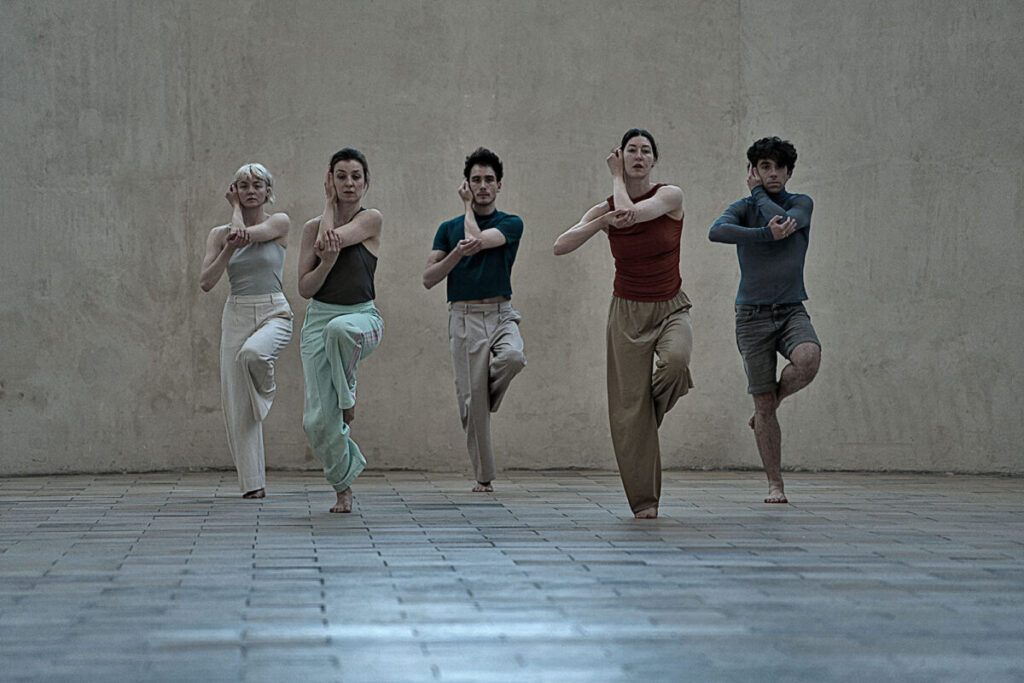
At this year’s Donaufestival in the secularized Dominican church in Krems, Lower Austria, Chris Haring and his company, Liquid Loft, presented HOLD&RESIST_a springrite in collaboration with the experimental noise-rock trio Radian. Five dancers continuously construct and dissolve fleeting spatial arrangements in the nave. Playing live with fragments from a sound archive, Radian’s noise-based practice unfolds alongside these shifting physical formations. Carrying, supporting, resisting, yielding, and holding are not rendered as static states, but enacted as active relationships. The core question is not what these configurations signify, but what they unlock between the figures: how one physical form may sustain another, how resistance turns into a condition of support, how individuals gather without merging, and how attempts at communication can remain unanswered.
From Sacrifice to Support
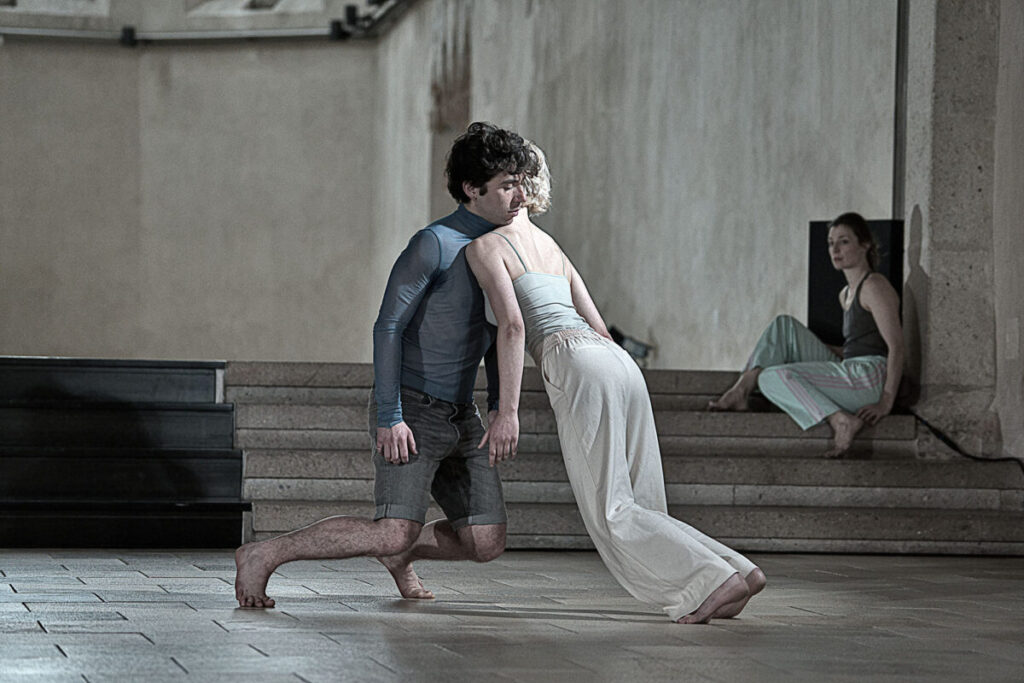
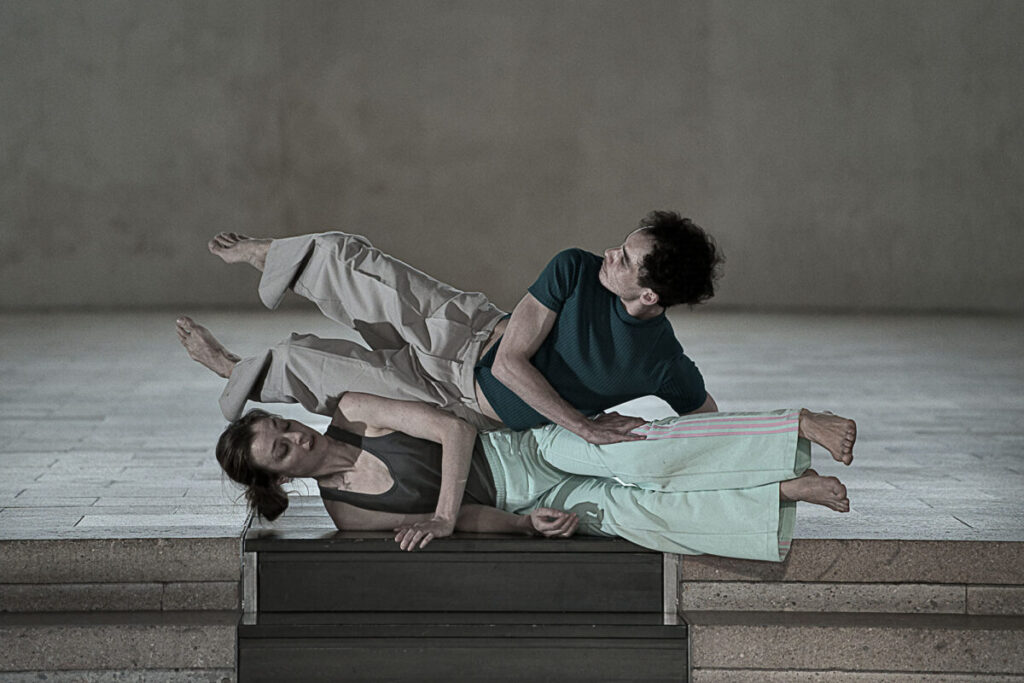
A kneeling man cradles a woman in his arms. Two figures lying on the floor mirror her posture, while a fifth, standing nearby, echoes the loose position of her arm. As one dancer bears another’s weight, the rest absorb, adapt, and pass on these physical cues. They continuously hold, yield, support, resist, and release one another. To interpret this configuration through the lens of the Pietà – a reference the work itself never invokes, yet whose formal resonance is difficult to ignore – is to project an image of death onto a dynamic scene. Rather than reproducing a sacrificial iconography, the ensemble deconstructs its actions and redistributes them: one carries, another yields, while others relay the movement.
This contrast with the Pietà illuminates the work’s underlying mechanism. In Michelangelo’s canonical image, the power of the motif lies in its precarious threshold: Christ’s body does not rest on the ground, but suspends in the arms of the Virgin, caught in the very moment of dying. Yet even as Mary sustains him, his weight remains fundamentally unresponsive. In HOLD&RESIST, by contrast, the carried body actively surrenders its weight for another to catch and transform. Her gesture does not remain isolated; it is received, echoed, and redistributed across the space. Yielding, therefore, does not dissolve into the stillness of death, but moves fluidly from one body to the next.
The subtitle a springrite introduces a second structural layer, one the work explicitly names: IgorStravinsky and Vaslav Nijinsky’s The Rite of Spring (Le Sacre du printemps , 1913); a historical watershedthat shattered classical ballet conventions through its raw visual language, violent rhythms, and radicalbodily demands. In the original work, the Chosen One is danced to complete exhaustion and ultimatelysacrificed, consuming a single figure so that the collective may be renewed. HOLD&RESIST neithersimply reproduces nor discards this canonical logic. Instead, it shifts the focus from bodily depletionand sacrificial loss toward the continuous act of mutual support. Rather than sacrificing an individualform for the community, the piece explores how bodies are sustained by one another.
The title itself articulates this shift. To hold means to keep another form from collapsing; to resist is tocounter the gravity drawing it downward. The seemingly passive figure, therefore, does not merelysurrender. She gives way only as someone else assumes her weight, trembling and offering frictioneven as she drops. Her physical frame exerts itself through the very process of yielding.
If yielding constitutes its own form of effort – if the trembling figure actively negotiates its descentrather than simply failing – exhaustion no longer marks the termination of action. As one body losesthe strength to sustain itself, another catches, supports, or carries it. What one physical form can nolonger endure, another takes up. Exhaustion thus shifts the movement away from the isolated individualtoward the relation between figures.
Exhaustion
Two figures tilt inward until forehead presses against forehead. Arms dangle limp or interlock at thenape. Standing collapses into an impossibility for either in isolation; to lean is to be caught, to buckleis to transfer mass. They anchor each other by gravity alone, locking into a single, shared point ofcontact.
Dependence here refrains from appearing as a flaw or a threshold to transcend. Instead, the dancerssculpt their stability directly out of it. Yet the very structure that sustains them simultaneously bindsthem. Bound by mutual reliance, neither can pivot away, break stride, or disengage. Support becomesa cage: they stabilize each other by constricting each other’s orbit.
What emerges is hardly solidarity in any triumphant key. They generate merely the baseline frictionrequired to prevent total collapse. The connection anchors them to the present spot without offeringpassage anywhere else.
Hope, under these conditions, refuses to project into a distant future. It shrinks to the immediate actof preserving a bond when neither frame can stand on its own. Yet enduring together remains distinctfrom building together – a rift that turns decisive in the sequence that follows.
Constellation
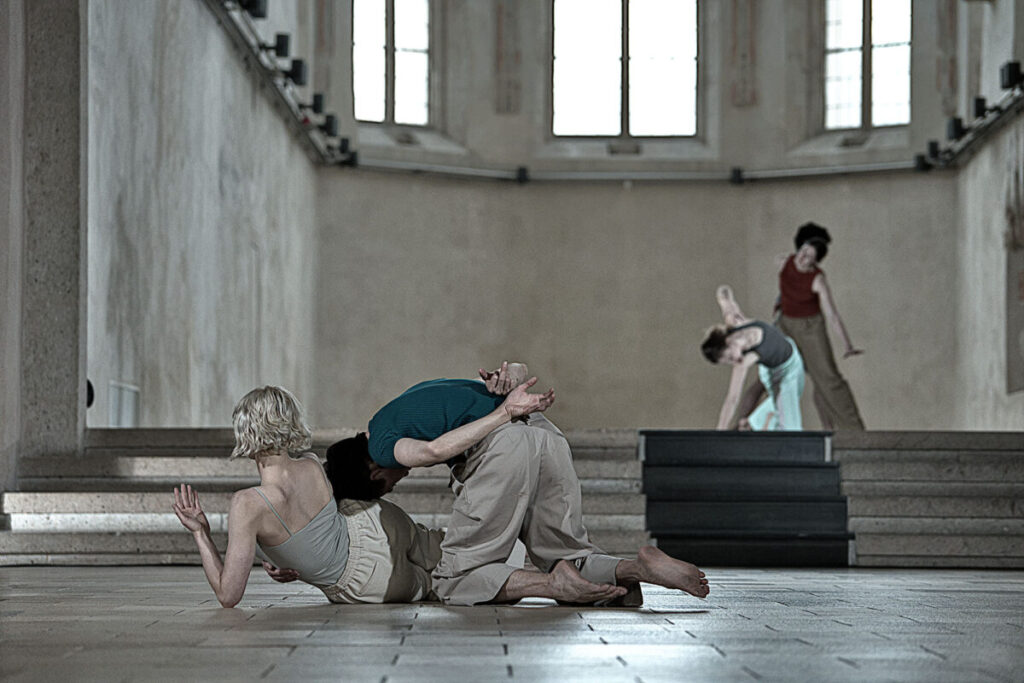
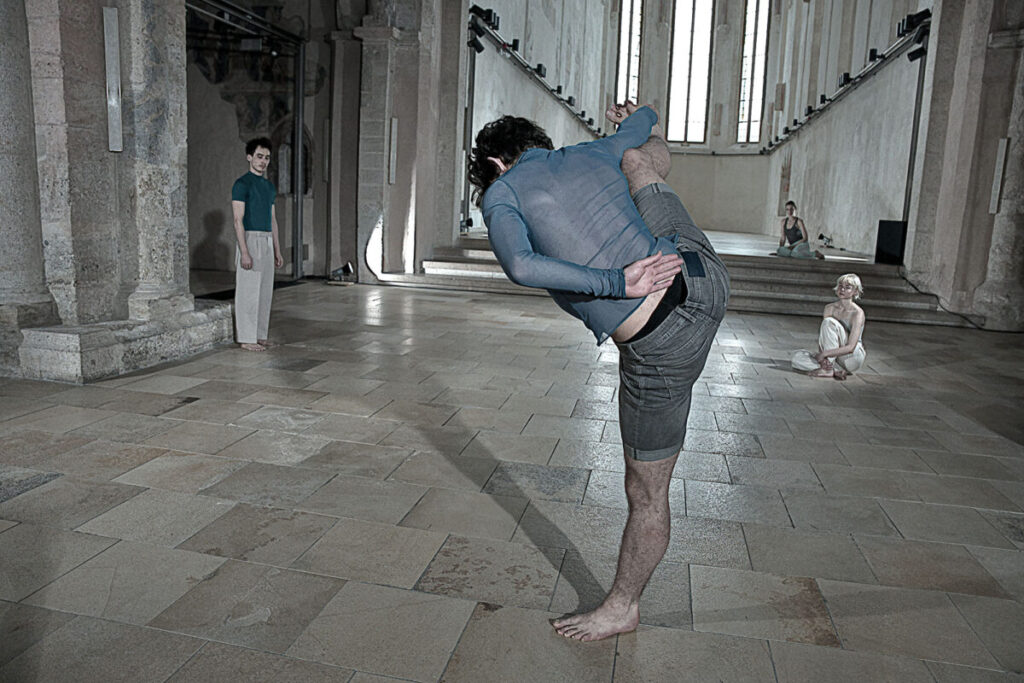
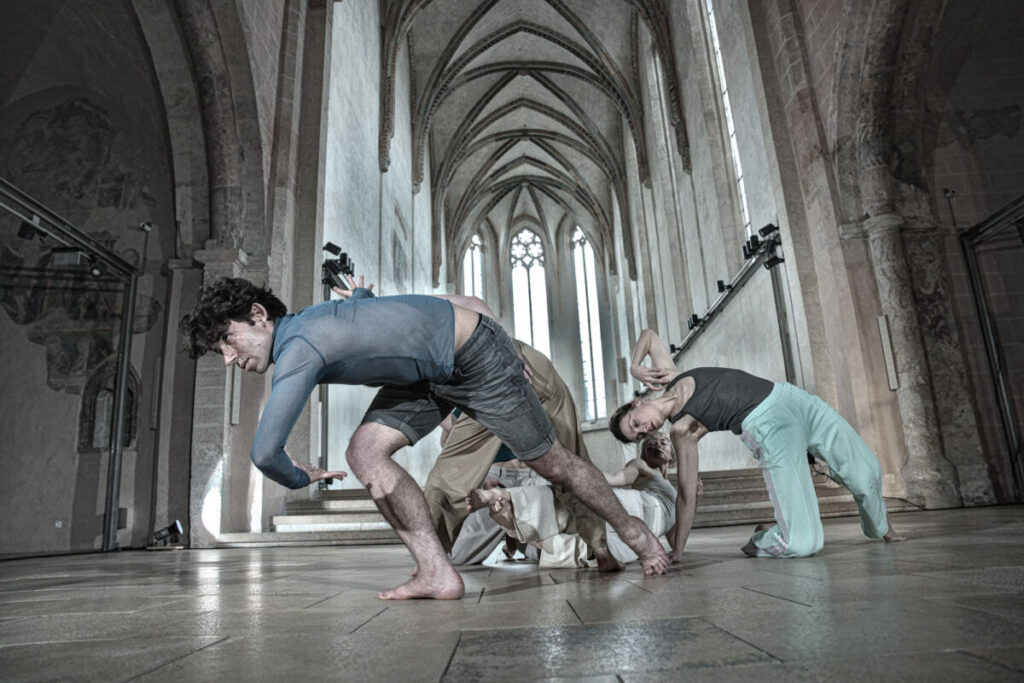
Having descended from the chancel into the nave, the dancers collapse onto the floor, folding, twisting, leaning, and extending into a dense cluster of singular frames. Movements no longer answer to one another. Each dancer executes a private sequence, occupying shared terrain without coalescing into a joint gesture. The spatial assembly gathers them without forcing integration – a state that is neither pure solidarity nor outright alienation, but the plain reality of shared space.
Out of this constellation, a contorted form reaches upward: feet braced against stone, torso coiling, a single arm thrusting vertically into space. The posture mirrors the figura serpentinata – not as a deliberate citation, but as a structural echo born of pure torsion. This silhouette evokes that Mannerist threshold where the harmonic unity of the Renaissance anatomy fractured. Elongation, spiraling tension, equilibrium lost: the physical frame no longer confirms an overarching order, but registers its rupture.
The piece displaces this dislocation from the isolated individual onto the group itself. Where the figura serpentinata compressed tension into a single body, the performance scatters it across multiple figures. No single dancer contains the whole; no gesture completes another. They coincide without aligning, populating the space without producing a collective subject.
What emerges is not a dramatic failure to relate, but a pragmatic refusal to synchronize. The performance does not resolve this tension into neat harmony, nor does it collapse into despair. It simply grants instability a physical form.
No Response
Returning to the chancel, the dancers stand framed by the Gothic choir window. One figure lies on the floor, propped on extended arms, her mouth opened in a silent scream. Behind her, another twists inward, pressing a hand to his ear. The scream fails to solidify into a message; the posture of listening yields no reply. What persists is the raw tension between an impulse to communicate and an attempt to receive.
Festival director Thomas Edlinger characterizes the core condition of HOLD&RESIST as a quiet commitment to endure, to stand firm, and to maintain one’s ground. This aligns precisely with the overarching theme of this year’s Donaufestival, Mad Hope , in that hope is severed from the guarantee of a specific outcome. The performance refrains from projecting a future collective order. Instead, it systematically tests what can endure between physical frames without congealing into a fixed form of community.
Here, the politics of the work become indistinguishable from the ritual logic it set out to dismantle. Le Sacre du printemps organizes collective renewal around the sacrifice of a single body – an expenditure of the individual to regenerate the group. Such a mechanism carries heavy historical weight: the immolation of the self in service of an imagined, monolithic collective echoes a deeply problematic motif in twentieth-century aesthetics. HOLD&RESIST categorically rejects this resolution. Its final scream generates no dogma, its listening yields no consensus, and its arrangements refuse to culminate in an image of achieved solidarity.
As a quiet guitar riff fades, the piece remains suspended rather than resolved. What persists is not the promise of a destination, but the ongoing labor of holding, resisting, supporting, and listening. HOLD&RESIST locates hope within connections sustained without a shared direction:carrying without claiming ownership, depending without erasing dependence, assembling without merging, and listening without the guarantee of an answer. Hope no longer dictates what the collective must become. It names the quiet capacity to remain in relation while leaving its outcome open.
Hope and Deliverance, Donaufestival Krems, 8. bis 10. Mai
Bernd Lederer, freiStil – Magazin für Musik und Umgebung
18. Mai 2026
[…] Erbaulich Neues hingegen bei Radian, diesmal in der Besetzung Martin Brandlmayr (dr), Martin Siewert (g) & Manu Mayr (b), die subtil, elegisch, feingliedrig, selten brachial, die wunderbare Tanz-Performance des Ensembles Liquid Loft begleiten und untermalen: Unter der Leitung von Chris Haring wird in der Choreografie Hold&Resist_a springrite freilich weniger getanzt, vielmehr werden ausdrucksstarke, skulpturale, statische Posen eingenommen und oft bis zur Erschöpfung lange durchgehalten. In der leeren, riesigen Dominikanerkirche korrespondieren Sound und Optik auf das Beeindruckendste zu einer Gesamtkomposition, ein Festivalhighlight! […]
Post-Club-Utopien. It’s a mad world, lass uns an der Utopie Hoffnung bauen: Das donaufestival 2026
Heinrich Deisl, FAQ
[…] Am zweiten Wochenendesteht die Uraufführung der Zusammenarbeit mit der Wiener Performancegruppe Liquid Loft an, dafür wird zum ersten Mal die Kremser Dominikanerkirche bespielt. Der Name dieserMusik-Tanz-Performance ist Programm: Bei „Hold & Resist“ geht es darum, Sounds und Posen in Einklang zu bringen und auszuhalten.Radian sind bekannt für ihre Grenzerfahrungen zwischen elektronischer und rockistischer Improvisation mit Ausflügen in abstrakten Jazz. Wie lebende Tableaux vivants bewegen sichTänzerinnen und Tänzer in (Ultra-)Slow-Motion zu den Klängen, verharren, kippen, balancieren. „Hold & Resist“ will sich auch politisch verstanden wissen, wonach demTrotzen der Schwerkraft auch der Impetus von Widerstand innewohnt. […]